
Two Repairs, Two Saved Service Calls
I had a commercial glass-door cooler that stopped cooling and a front-load washer that got stuck with the door locked and the pump running nonstop. Both are essential to our farm and homestead, but I didn’t want to spend $600–$1,000 each on repair calls, so I simply delayed fixing them for months. On a whim, I decided to use Claude as my personal appliance repairman to see if it could help me diagnose either issue — and I was genuinely surprised by the outcome.
Quick Answer
I used Claude to diagnose two broken appliances — a commercial cooler and a front-load washer — by describing exactly what I was seeing, in plain language, and answering follow-up questions as it narrowed down the cause. Total parts cost for both repairs: under $50. Between the two, we likely saved $1,200–$2,000 in service calls, and the cooler — which had been sitting broken for 8 months — was back up and running within days of actually trying.
Why the Cooler Mattered Enough to Bother
The cooler holds all of our garden harvest and prepped food before it gets processed — bags of spinach, multiple dozen eggs, bacon mid-cure, and whatever else is in progress on a given week. None of that fits in our counter-depth kitchen fridge, so this commercial cooler is genuinely essential to how our homestead runs. It just also happened to be broken for 8 months, because the idea of a $600+ repair call kept getting pushed to “next week.”
How I Talked Through the Fridge Repair
I opened Claude and started simple, describing exactly what was happening:
“I have a commercial fridge (Coldtech J1GR-24L) that cools for about 24-48 hours and then kicks off. Fan continues to run but no cooling occurs. It doesn’t appear to ice up anywhere. Help me troubleshoot and pinpoint the problem with step by step instructions.”
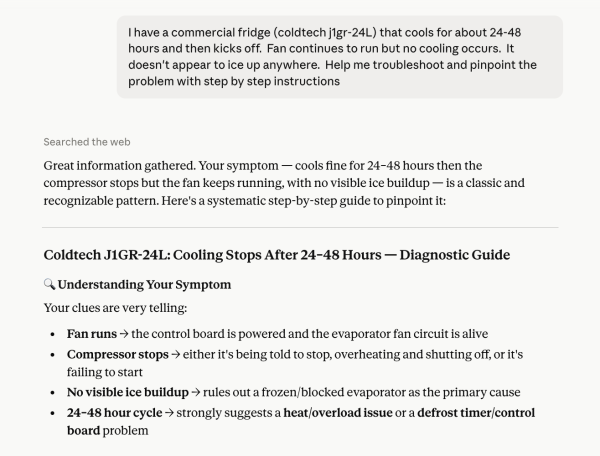
That single prompt came back with six specific things to check, with details on how to check each one and whether it was a reasonable DIY job or something to leave alone. Already more useful than I expected.
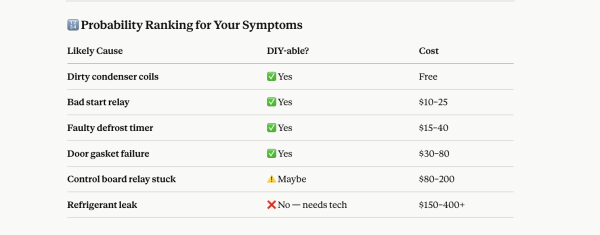 From there, it was just a back-and-forth conversation as I gathered more information:
- I mentioned the failure happened more often in extreme heat, but also in shoulder seasons, and that it seemed to warm up the garage it’s stored in. Claude suggested cleaning the coils.
- After cleaning the coils and giving it 24 hours, I reported back: the fan was running, you could hear it calling for the condenser, but the condenser wasn’t doing anything. With that detail, Claude was fairly confident it was a bad start relay or a bad overload protector — both parts running about $15 each.
I ordered the parts, asked a couple of clarifying questions about how to actually remove and replace them, and swapped them out myself. The fridge cooled almost immediately and has held steady for the last month.
How I Talked Through the Washer Repair
Our front-load washer — the one we use for horse blankets — got stuck in a door-fault loop: pump running, door locked, flashing lights, no way to reset or turn it off. Local repair techs in our area charge a $300 minimum just to show up, and seem to always find something bigger to sell you on top of that. The problem felt like it should be simple, so I gave Claude the details:
“We have a Whirlpool Duet washer that was run without water turned on to it, and now it is trying to drain with the pump, running with a flashing door lock light and no ability to reset it or turn it off.”
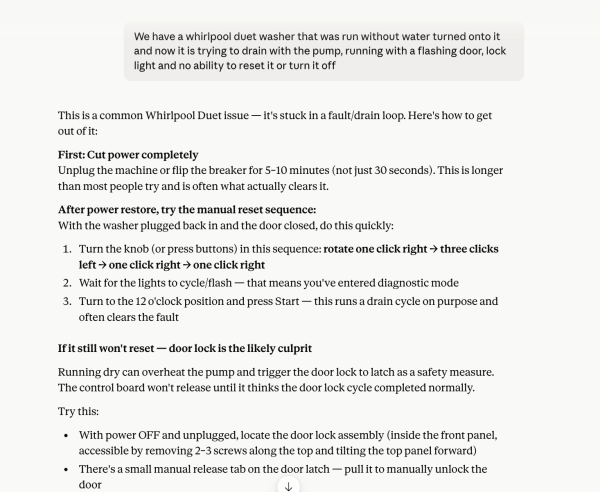
I’ll admit, I didn’t think this one was going to work. The first couple of reset sequences it suggested didn’t do anything. But I kept describing what was actually happening and eventually shared a photo of the washer’s control panel so it could see the exact buttons and lights I was working with. With that, Claude recommended holding the cancel button for a full 3 seconds — which, as it turns out, is written right on the washer’s control panel — and the washer reset and finished its cycle normally. Another service call avoided entirely.
What It Actually Cost vs. What It Saved
The cooler repair parts ran about $30 with shipping, plus some sweat equity getting into a hard-to-reach spot. The washer fix cost nothing — it was simply knowing which button to hold and for how long. Looking back, the cooler sitting broken for 8 months feels almost silly now, given the entire fix was a $30 part and an afternoon.
Between the two repairs, we likely saved somewhere between $1,200 and $2,000 in service calls.
Where I Draw the Line
This isn’t a case for skipping a technician altogether. Gas lines, refrigerant, and real electrical work are firmly outside our DIY comfort zone, and that’s not changing. What this is genuinely useful for is getting a clear handle on the problem before deciding whether it’s a DIY fix or a call to a professional. And even when the DIY attempt doesn’t fully solve it, having already ruled out the simple causes means a technician can skip straight past those steps — which can shrink the time, and the cost, of the visit that follows.
FAQ
Can AI actually diagnose a broken appliance accurately? It can narrow things down significantly when you describe symptoms clearly — error codes, sounds, what happens when you try to run it. It won’t replace a technician for anything involving gas, refrigerant, or electrical work, but it’s a strong first step for figuring out what’s actually wrong.
What information should I have ready before asking for help diagnosing an appliance? The make and model, the exact symptoms (sounds, lights, error codes), what you’ve already tried, and ideally a photo of the controls or display if something seems off there. The more specific the description, the more useful the answer.
Is it worth attempting a DIY repair before calling a technician? For anything that isn’t gas, refrigerant, or high-voltage electrical work, yes — worst case, you’ve spent a small amount on parts and ruled out the simple causes, which can also reduce the technician’s time (and cost) if you do end up calling one.